What Does a $5K, $10K, or $20K Wedding Budget Really Get You?
One of the hardest parts of wedding planning is figuring out what a number on a spreadsheet actually means.
Is $5,000 enough for a wedding?
What changes when the budget becomes $10,000?
And does a $20,000 wedding automatically feel twice as impressive?
Not necessarily.
The amount you spend matters, but how you allocate it matters just as much.
A small restaurant wedding with incredible food and photography can feel more intentional than a much more expensive celebration where the budget is spread across dozens of things the couple does not particularly care about.
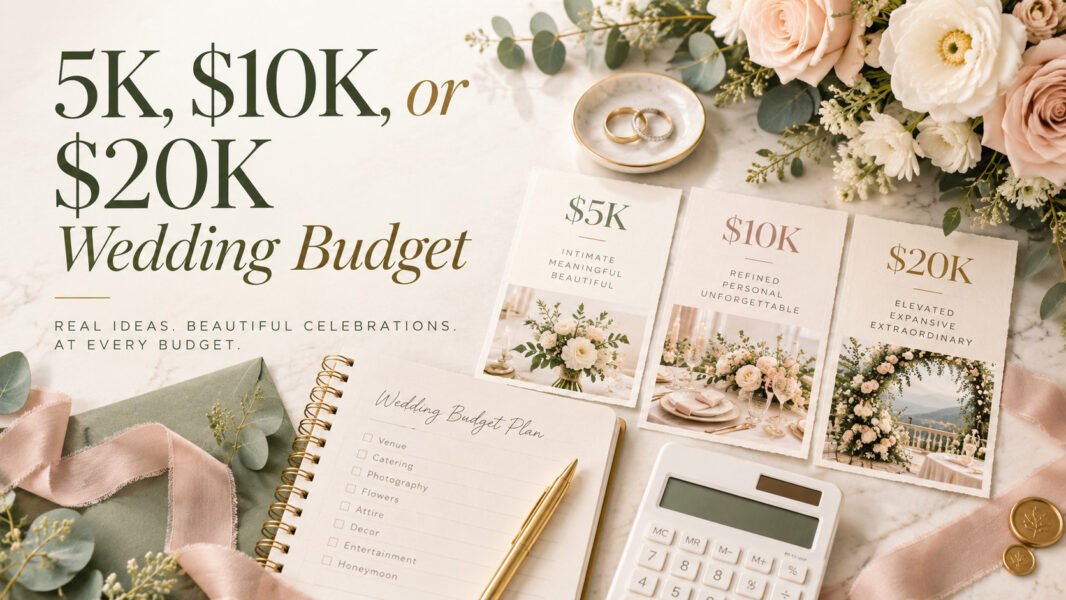
Below, we will compare three example wedding budgets:
- $5,000
- $10,000
- $20,000
These are planning examples, not universal price quotes. Actual costs can vary significantly depending on your location, guest count, season, venue, vendors, and what you choose to prioritize.
Before booking anything, you can use VowVirtue’s free Wedding Budget Calculator to create a budget based on your own total.
First: Your Guest Count Changes Everything
A $10,000 wedding for 30 guests is very different from a $10,000 wedding for 150 guests.
Many wedding costs increase as your guest list grows, including:
- catering
- drinks
- tables and chairs
- rentals
- invitations
- favors
- cake or dessert
- transportation
- venue requirements
That means two couples with exactly the same total budget may have completely different weddings.
If you want more flexibility without increasing your budget, guest count is one of the most powerful variables you can change.
The $5,000 Wedding: Small, Intentional, and Flexible
A $5,000 wedding usually requires clear priorities.
Trying to recreate every element of a traditional large wedding on this budget can quickly become frustrating.
Instead, think about creating a smaller celebration and spending deliberately on the parts you care about most.
Here is one possible allocation:
| Category | Example Budget |
|---|---|
| Venue / ceremony space | $750 |
| Food & drinks | $1,500 |
| Photography | $800 |
| Attire | $450 |
| Flowers & décor | $350 |
| Music | $200 |
| Invitations / stationery | $100 |
| Cake / dessert | $250 |
| Legal fees, tips, transport & buffer | $600 |
| Total | $5,000 |
Again, these numbers are examples rather than expected vendor prices.
What might a $5K wedding look like?
A $5,000 wedding may work especially well for:
- an intimate guest list
- backyard weddings
- restaurant celebrations
- community spaces
- courthouse ceremony plus reception
- brunch weddings
- weekday weddings
- ceremony followed by dinner rather than a full traditional reception
You will probably need to make some conscious trade-offs.
For example:
Professional photographer, but no videographer.
Restaurant dinner, but minimal décor.
Beautiful ceremony venue, but digital invitations.
Smaller guest list, but better food.
That is not automatically a compromise.
It can simply be a more focused wedding.
Where a $5K budget gets difficult
Problems usually begin when the couple wants:
- a large guest count
- full-service catering
- premium venue
- elaborate florals
- professional photo and video
- live entertainment
- open bar
- extensive rentals
all within the same $5,000.
The solution is not necessarily finding cheaper versions of everything.
Often the better approach is removing entire categories you do not care about.
The $10,000 Wedding: More Room to Choose
At $10,000, couples generally have more flexibility.
You still need priorities, but you may be able to hire professionals for several important parts of the day while keeping other areas simple.
Here is one example:
| Category | Example Budget |
|---|---|
| Venue | $1,800 |
| Food & drinks | $3,000 |
| Photography | $1,500 |
| Attire | $800 |
| Flowers & décor | $600 |
| Music | $600 |
| Invitations / stationery | $200 |
| Cake / dessert | $300 |
| Hair & makeup | $300 |
| Miscellaneous & buffer | $900 |
| Total | $10,000 |
What can $10K give you?
Depending on guest count and location, you may have room for:
- a dedicated venue
- professional photography
- catered meal
- DJ
- florist for key arrangements
- wedding attire with professional alterations
- printed invitations
- professional hair and makeup
But you may still choose not to pay for everything.
For example, you might skip:
- elaborate favors
- large floral installations
- custom stationery suites
- luxury transportation
- multiple entertainment acts
- extensive rental upgrades
A $10K budget often works best when you decide what should feel professional and polished and what can remain simple.
The $20,000 Wedding: More Full-Service Options
A $20,000 budget can open more possibilities, especially if the guest count remains controlled.
Here is one sample allocation:
| Category | Example Budget |
|---|---|
| Venue | $3,500 |
| Food & drinks | $6,500 |
| Photography / video | $3,000 |
| Attire | $1,800 |
| Flowers & décor | $1,500 |
| DJ / entertainment | $1,000 |
| Coordination | $900 |
| Stationery | $400 |
| Hair & makeup | $400 |
| Cake / dessert | $400 |
| Miscellaneous & buffer | $600 |
| Total | $20,000 |
At this level, couples may have more room to hire professionals rather than handling multiple tasks themselves.
That could mean:
- professional venue
- catered reception
- open or hosted bar
- photography and some video coverage
- professional florist
- DJ
- coordinator
- professional beauty services
- upgraded attire
- more detailed stationery
But even $20,000 can disappear quickly if the guest count becomes very large or if several premium categories are chosen at once.
A larger budget does not eliminate the need to prioritize.
It simply gives you more options.
$5K vs. $10K vs. $20K: What Actually Changes?
The biggest difference is not necessarily how beautiful the wedding looks.
It is often how much complexity you can outsource.
With $5K
You may need to:
- choose a smaller venue
- keep the guest list tight
- DIY some décor
- use simpler catering
- handle more planning yourself
- skip lower-priority services
With $10K
You may be able to:
- hire professional vendors in several categories
- choose a more traditional reception setup
- reduce DIY work
- offer more food and drink options
- add professional beauty or entertainment services
With $20K
You may have room to:
- hire more full-service vendors
- upgrade venue or catering
- add coordination
- improve photography/video coverage
- invest more heavily in décor or entertainment
- reduce the number of things you personally manage
The key difference is often not more things.
It is more convenience, service, and choice.
Don’t Split Your Wedding Budget Equally
One of the easiest ways to waste money is treating every wedding category as equally important.
They probably are not.
Ask each other:
If we could only make three parts of the wedding amazing, which three would we choose?
Your answers might be:
- food
- photography
- music
Another couple might choose:
- venue
- flowers
- attire
Another might care most about:
- guest experience
- drinks
- entertainment
All three answers are valid.
Once you know your priorities, the budget becomes easier.
Spend more where you will notice the difference.
Simplify where you will not.
For another way to think about allocation, see our Wedding Budget Breakdown: Where Should Your Money Go?.
The Hidden Costs That Can Break a Wedding Budget
The headline price from a vendor may not always be the final amount you pay.
When comparing proposals, check for expenses such as:
- taxes
- service charges
- gratuities
- setup fees
- delivery
- cleanup
- overtime
- travel
- vendor meals
- rental fees
- corkage
- cake-cutting fees
- ceremony fees
- security requirements
- insurance
- parking
- permits
Not every wedding will have all of these.
The important thing is to ask:
“What is not included in this quote?”
That question can prevent a lot of surprises later.
Build a Buffer Before You Start Spending
A common planning mistake is allocating 100% of the available money immediately.
For example, if you have exactly $10,000 available, do not necessarily make your initial plan add up to exactly $10,000.
Leave room for things you have not discovered yet.
A buffer can help with:
- final guest-count changes
- alterations
- vendor overtime
- delivery
- last-minute rentals
- transportation changes
- forgotten accessories
- tips
- unexpected weather needs
You do not need to predict every possible expense.
You simply need enough flexibility that one surprise does not force you to rewrite the entire budget.
Where Should You Splurge?
A splurge makes sense when three things are true:
- it matters personally to you
- you will actually notice the difference
- increasing the budget there does not create financial stress elsewhere
For example, photography may be worth prioritizing if photographs are especially important to you.
But that does not mean every couple needs the most expensive photographer available.
The same logic applies to:
- food
- drinks
- entertainment
- attire
- flowers
- venue
Spend intentionally rather than automatically.
Where Can You Save?
There are several places where couples can often simplify without changing the heart of the celebration.
Guest list
Fewer guests can reduce multiple categories at once.
Date and time
Depending on venue and location, less in-demand days or times may offer more options.
Stationery
Digital communication can replace some printed pieces.
Décor
A venue that already looks good may require less decoration.
Flowers
Prioritize arrangements that appear in important photos and guest-facing spaces.
Cake
A smaller display cake plus another dessert option may fit some weddings better.
Transportation
If ceremony and reception are at the same location, transportation becomes much simpler.
The point is not to make your wedding look cheap.
It is to stop paying for things that do not improve the experience you actually want.
Don’t Forget the Drinks Budget
Alcohol and beverages can become a significant part of reception spending because the amount depends on:
- guest count
- reception length
- percentage of guests drinking
- beer/wine/spirit mix
- non-alcoholic options
- venue or corkage rules
Rather than guessing how many bottles to buy, use the free Wedding Beverage Calculator.
It estimates quantities for:
- beer and cider
- wine
- spirits
- mixers
- water
- zero-proof drinks
You can also download the result as a PDF for your planning notes.
A Better Way to Build Your Wedding Budget
Instead of starting with dozens of individual purchases, work from the top down.
Step 1: Decide your absolute maximum
How much can you comfortably spend without depending on money that is uncertain?
Step 2: Estimate your guest count
This affects many of your largest categories.
Step 3: Identify your three priorities
Decide where spending more will actually improve the wedding for you.
Step 4: Create your first allocation
Use VowVirtue’s free Wedding Budget Calculator to create a starting structure.
Step 5: Get real quotes
Your calculator gives you a framework.
Vendor quotes tell you how that framework compares with your actual market.
Step 6: Adjust
If one category comes in higher than expected, do not simply increase the total.
Ask whether another category can be reduced.
Step 7: Keep a buffer
Do not spend the last dollar before the wedding arrives.
What Matters More Than the Total Wedding Budget?
A good wedding budget is not the one with the biggest number.
It is the one where the couple understands why each major expense is there.
A $5,000 wedding can feel thoughtful and complete.
A $10,000 wedding can still require compromises.
A $20,000 wedding can still go over budget.
And a much larger wedding can still feel stressful if every decision is being made without priorities.
The goal is not:
“How much wedding can we buy?”
A better question is:
“What kind of wedding do we actually want our budget to create?”
Once that is clear, the numbers become much easier to manage.
Start With Your Own Number
The examples above can help you understand the trade-offs, but your wedding will have its own guest count, location, priorities, and vendor options.
Start with the number you actually plan to spend.
Then let the budget work backward from there.
Use the free Wedding Budget Calculator to build your first allocation.
You may also want to read:
- How to Create a Wedding Budget That Actually Works
- Wedding Budget Breakdown: Where Should Your Money Go?
- Your No-Panic Wedding Planning Timeline
- Wedding Beverage Calculator
Planning does not get easier because every expense becomes cheaper.
It gets easier when you know what deserves your money—and what does not.