
How to Write a Wedding Speech People Will Actually Remember
Learning how to write a wedding speech doesn’t have to be complicated. A memorable speech starts with a personal story, a meaningful message about the couple, and a heartfelt toast that celebrates their future together. You don’t need to be a professional writer or a confident public speaker to create something special.
For most wedding speakers, a speech lasting around three to five minutes is a practical starting point. That’s roughly 350–650 words, depending on how quickly you speak and how often you pause.
But knowing what to say can be surprisingly difficult.
Maybe you’re the best man trying to balance humor with sincerity. Perhaps you’re a maid of honor with too many memories to choose from. Or you might be a parent who wants to express years of love and pride without becoming overwhelmed by emotion.
Whatever your role, the goal is the same: to celebrate the couple in a way that feels personal, thoughtful, and true to you.
In this guide, you’ll learn two things:
- The 7 simple steps to writing a wedding speech, from choosing your message and finding the right story to preparing a memorable closing toast.
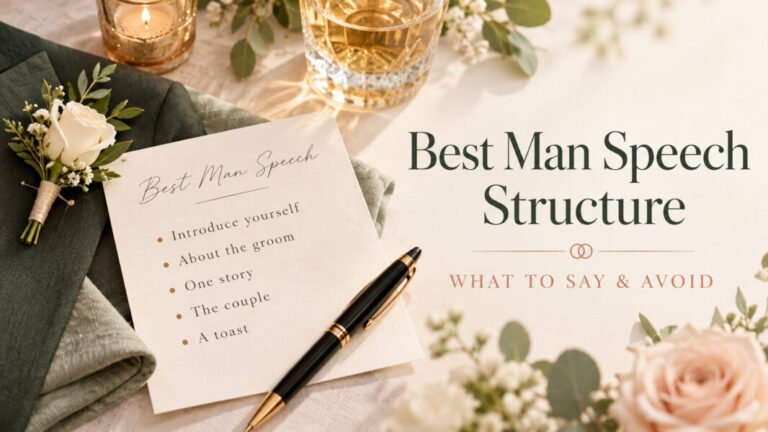
- The VowVirtue Five-Part Wedding Speech Framework, a simple structure for organizing your finished speech: Opening → Story → Meaning → Couple → Toast.
You’ll also find a ready-to-use wedding speech template, real-world examples for different speaking roles, and practical tips for delivering your words with confidence.
Key Takeaways
- Start with one clear message. Decide what you want guests to remember about the couple before writing your speech.
- Choose one or two meaningful stories. Personal memories are more memorable than a long list of generic compliments.
- Keep the humor kind. A wedding speech should celebrate the couple, not embarrass them.
- Talk about both partners. Even if you know one person much better, bring the focus back to their relationship.
- Aim for three to five minutes. A focused speech is often more enjoyable than a lengthy one.
- Finish with a genuine toast. End with a warm wish that gives everyone a reason to raise their glasses.
What Makes a Good Wedding Speech?
A good wedding speech feels personal, easy to follow, and genuinely connected to the couple.
It doesn’t need to be the funniest speech of the night. It doesn’t need to make everyone cry, either.
The best speeches usually help guests understand something meaningful about the newlyweds through a story, observation, or heartfelt message.
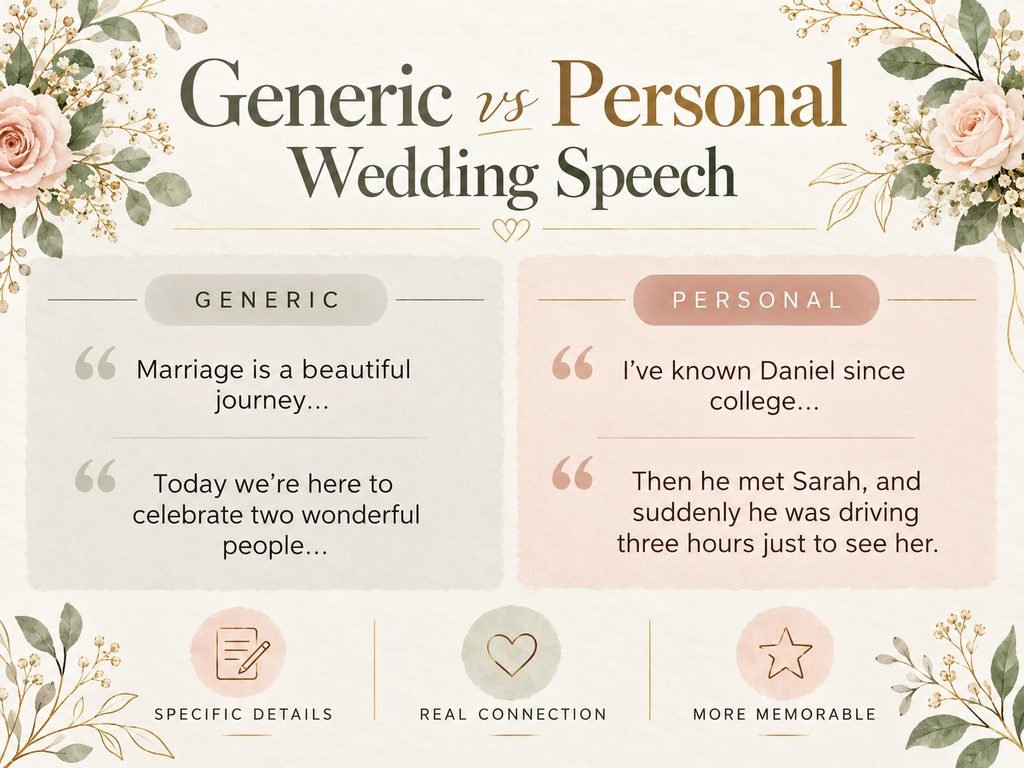
Consider these two openings.
Generic:
“Marriage is a beautiful journey, and today we’re celebrating two wonderful people who have found true love.”
Personal:
“I’ve known Daniel since college, and for years I thought nothing could make him more excited than a weekend hiking trip. Then he met Sarah, and suddenly he was driving three hours just to spend an afternoon with her.”
Both express positive feelings, but the second gives guests a glimpse into Daniel’s personality and relationship.
It feels more memorable because it’s specific.
Three Qualities Every Memorable Wedding Speech Needs
| Element | Why It Matters | Example |
|---|---|---|
| Personal connection | Establishes your relationship with the couple | “I’ve been friends with Emma since college.” |
| Meaningful story | Reveals something special about the relationship | “I knew James was important when Emma started saving every funny story to tell him.” |
| Heartfelt message | Celebrates the couple’s marriage and future | “May you always find reasons to laugh, support each other, and enjoy the little moments.” |
You can include humor, emotion, or a combination of both.
The important thing is that every story and observation supports your central message.
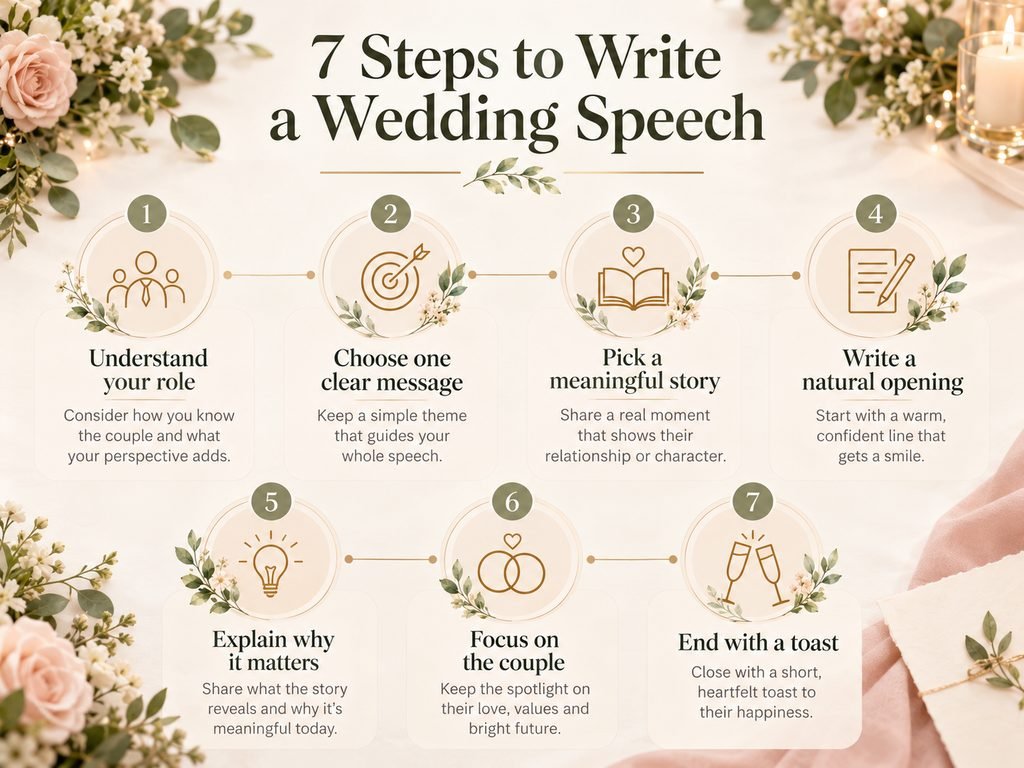
How to Write a Wedding Speech in 7 Simple Steps
If you’re staring at a blank page, don’t start by trying to write the perfect opening.
Begin with what you know about the couple and what you genuinely want to say.
Step 1: Understand Your Role and Audience
Your role influences the tone and content of your wedding speech.
A best man might share a funny story about a longtime friendship. A parent may focus on pride, family memories, and welcoming a new family member.
Here are some common approaches.
Best man: Share a meaningful friendship story, highlight positive qualities, and celebrate the relationship.
Maid of honor: Talk about your friendship, what you admire, and how the relationship has brought happiness to the couple.
Parent: Express love, pride, gratitude, and hopes for the newlyweds.
Sibling: Include a warm family memory and celebrate your sibling’s new chapter.
Friend: Focus on your connection to the couple and what makes their partnership special.
Bride or groom: Thank guests and loved ones, acknowledge your partner, and express appreciation.
These are suggestions rather than strict traditions. Wedding roles vary across families and cultures.
Before writing, ask the couple or wedding planner about the speech order, expected length, and any topics they would prefer to avoid.
Step 2: Start With One Clear Message
Before writing your opening line, decide what you want people to remember after you sit down.
This is the most useful way to keep your speech focused.
Maybe your message is that the groom has always been dependable and has found someone who appreciates that quality.
Perhaps it’s that the bride has spent years caring for everyone around her and has found a partner who shows her the same kindness.
Or maybe you want to celebrate how naturally the couple brings out the best in each other.
Try finishing this sentence:
“If guests remember only one thing from my speech, I want them to remember that ______.”
For example:
“I want everyone to remember that Emma and James have built a relationship around friendship, kindness, and making each other laugh.”
Once you’ve chosen your message, use it to guide the stories and details you include.
If something doesn’t support that message, you probably don’t need it.
Step 3: Choose One or Two Meaningful Stories
A personal story can turn an ordinary wedding speech into something guests remember.
But choosing the right story matters more than choosing the funniest one.
Think about memories that reveal something positive about the couple.
Ask yourself:
- What’s one moment that always makes me smile?
- When did I first notice how important this relationship had become?
- What quality does this story reveal?
- Will guests understand the story without a long explanation?
- Would both partners feel comfortable hearing it in public?
For example:
“When Rachel first told me about Chris, she mentioned that he’d driven across town to bring her soup when she was sick. It wasn’t a grand romantic gesture. But Rachel, who usually insists she can handle everything herself, seemed genuinely happy that someone had taken care of her.”
This story works because it reveals something about the relationship.
It shows care, kindness, and thoughtfulness.
You don’t need to cover every milestone in the couple’s history.
One carefully chosen memory is often enough.
Step 4: Write an Opening That Feels Natural
Your opening should introduce you, establish your connection to the couple, and help everyone settle into your speech.
You don’t need a dramatic joke or complicated introduction.
Here are some examples.
Best man opening:
“Good evening, everyone. I’m Michael, and I’ve had the privilege of being Daniel’s best friend for almost fifteen years.”
Maid of honor opening:
“Hi, everyone. I’m Jessica, Emma’s maid of honor and the person who’s been lucky enough to call her my best friend since college.”
Parent opening:
“Thank you all for being here to celebrate this wonderful day. As Sarah’s dad, it’s difficult to describe how proud I feel standing here tonight.”
Sibling opening:
“Hi, everyone. I’m Alex, Jamie’s older brother. Growing up together gave me plenty of stories to share tonight, but I promise I’ve chosen one Jamie won’t regret.”
Newlywed opening:
“Before we continue celebrating, we want to thank everyone who traveled, supported us, and helped make this day possible.”
Keep your introduction short.
Once guests understand who you are, move naturally into your story.
Step 5: Explain Why Your Story Matters
A story becomes meaningful when you connect it to the person or relationship you’re celebrating.
Imagine telling a story about a friend who stayed up late helping you prepare for an important exam.
That memory demonstrates loyalty, but it doesn’t automatically explain what makes the couple’s relationship special.
You could add:
“That was the kind of friend Daniel was then, and it’s the kind of partner I’ve watched him become with Sarah. He shows up for the people he loves, especially when life gets difficult.”
Now the story has a purpose.
It helps guests understand Daniel’s character and connects that quality to his marriage.
This is also where you should begin including both partners.
Even if you know one person much better, try to describe what you’ve genuinely observed about their relationship.
For example:
“I haven’t known Taylor as long as I’ve known Morgan, but I’ve seen how much more relaxed, confident, and happy Morgan becomes when they’re together.”
You don’t need to pretend you know both people equally well.
Sincere observations are better than invented closeness.
Step 6: Bring the Focus Back to the Couple
One of the most common wedding speech mistakes is talking almost entirely about the person you know best.
A best man might spend four minutes telling stories about the groom and mention the bride only in the final sentence.
A maid of honor might focus exclusively on her friendship with the bride.
But the wedding is about the couple.
After telling your story, explain what you appreciate about their relationship.
You might mention:
- How they support each other’s goals.
- How they handle challenges together.
- The kindness they show each other.
- Their shared sense of humor.
- The way their personalities complement each other.
- How their relationship has helped them grow.
For example:
“Watching Emma and James together has shown me that a wonderful relationship isn’t only about big romantic gestures. It’s about friendship, patience, and showing up for each other in ordinary moments.”
This brings your speech back to the reason everyone is celebrating.
Step 7: End With a Genuine Wedding Toast
Your closing should feel deliberate.
Don’t introduce another story or suddenly change the subject.
Instead, finish with a warm wish for the couple.
For example:
“My wish for both of you is that you never lose the friendship that brought you together. May you always find reasons to laugh, make time for each other, and face life’s unexpected moments as a team.”
Then invite guests to raise their glasses.
“Please raise your glasses to Emma and James. May your marriage be filled with laughter, patience, adventure, and love. To the newlyweds!”
You don’t need a dramatic final sentence.
A clear, sincere toast is enough.
The VowVirtue Five-Part Wedding Speech Framework
If you’re unsure how to organize your ideas, use the VowVirtue Five-Part Wedding Speech Framework.
It follows a simple progression:
Opening → Story → Meaning → Couple → Toast
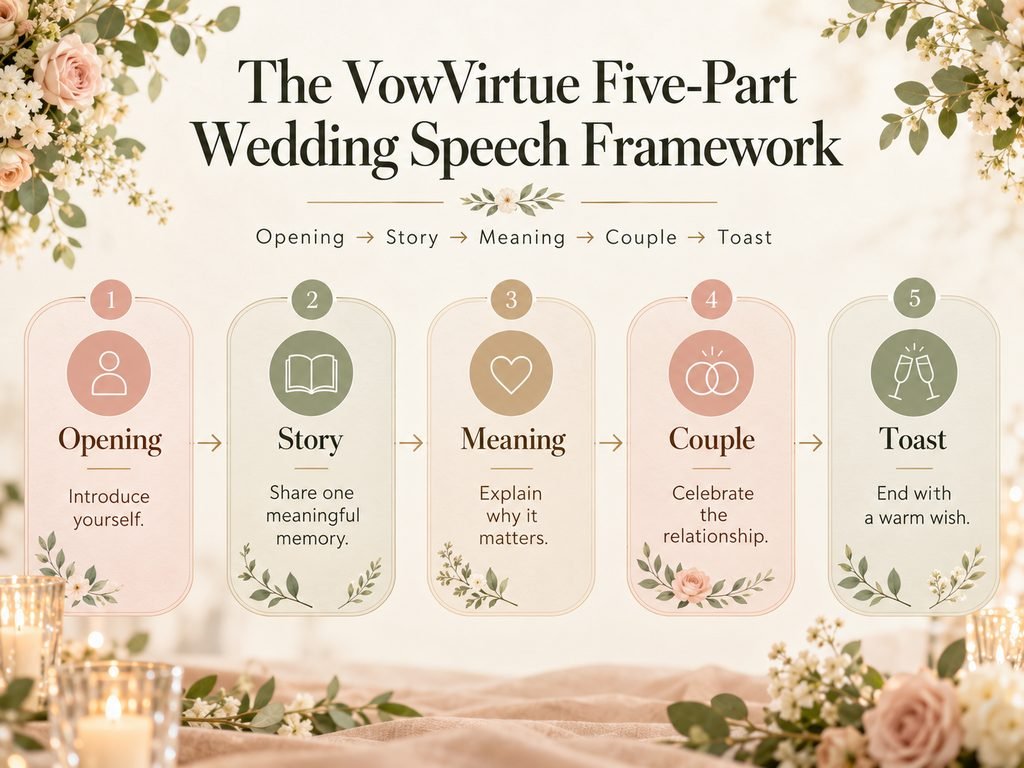
| Part | What to Include | Example |
|---|---|---|
| 1. Opening | Introduce yourself and your connection | “I’m Alex, and I’ve known Jamie since childhood.” |
| 2. Story | Share a meaningful memory | “I still remember the first time Jamie introduced us to Taylor.” |
| 3. Meaning | Explain what the story reveals | “I could see how comfortable and happy they were together.” |
| 4. Couple | Celebrate their relationship | “They’ve built something special through kindness, humor, and friendship.” |
| 5. Toast | End with a heartfelt wish | “Here’s to a lifetime of love, laughter, and wonderful adventures!” |
This framework works for best men, maids of honor, parents, siblings, and friends.
It also adapts to speeches from the newlyweds.
For example, a bride or groom can replace the personal story with a short reflection about the wedding journey and use the final sections to thank loved ones.
The goal is not to follow a rigid formula.
It’s to create a speech that has a clear beginning, middle, and ending.
Fill-in-the-Blank Wedding Speech Template
Not sure where to begin?
Use this template to turn your thoughts into a complete speech.
Replace the bracketed sections with details from your own experience.
“Good evening, everyone!
For those I haven’t met, my name is [your name], and I’m [your relationship to the couple].
I’ve known [person’s name] for [length of time], and one thing I’ve always admired is [positive quality].
I remember [brief meaningful memory].
That moment showed me [what the story reveals about their personality or values].
When [partner’s name] came into the picture, I noticed [something meaningful about the relationship].
Together, they share [quality or value you admire about the couple].
As they begin this new chapter, my wish for them is [heartfelt wish].
Please join me in raising a glass to [couple’s names].
May your life together be filled with [three positive wishes].
Cheers!”
Once you’ve filled in the blanks, read the entire speech aloud.
Remove phrases that feel too formal, shorten unnecessary explanations, and add details that make the message uniquely yours.
If you need help organizing your memories and preferred tone, the VowVirtue Wedding Speech Generator can create a personalized starting draft that you can review and edit.
How Long Should a Wedding Speech Be?
Three to five minutes is a useful target for many wedding speeches, but shorter is often better when several people are speaking.
The ideal length depends on your role, the couple’s preferences, and the reception schedule.
| Speech Type | Approximate Length | Word Count |
|---|---|---|
| Short wedding toast | 1–2 minutes | 125–250 words |
| Standard wedding speech | 3–4 minutes | 350–500 words |
| Extended wedding speech | 4–5 minutes | 500–650 words |
These are flexible estimates, not strict requirements.
Speaking speed varies, especially when you pause for laughter or become emotional.
A speech that looks short on paper might take longer than expected.
Read your draft aloud with a timer and adjust it to fit the time you’ve been given.
If you’re helping organize when speeches will happen, the VowVirtue Wedding Timeline Generator can help create a practical schedule for speeches, dinner, and other important reception moments.
Wedding Speech Examples for Different Roles
Every wedding speech should reflect the speaker’s relationship with the couple.
The following original examples show how the same five-part structure can work across different roles.
Best Man Wedding Speech Example
“Good evening, everyone. I’m Michael, Daniel’s best man and longtime friend.
I’ve known Daniel for almost fifteen years, and if there’s one thing I’ve learned about him, it’s that he’s someone you can always count on.
When we were younger, Daniel was the friend who would help you move apartments, pick you up when your car broke down, or stay up late listening when you needed someone to talk to.
He also has a habit of being twenty minutes early to absolutely everything.
When he met Sarah, I started noticing something different.
He was still the same loyal, dependable person, but he seemed happier and more excited about the future.
And after getting to know Sarah, it was easy to understand why.
Sarah, you bring so much warmth, humor, and energy into Daniel’s life. Together, you make an incredible team.
I hope your marriage is filled with the same friendship, patience, and laughter that have brought you to this day.
So, everyone, please raise your glasses.
To Daniel and Sarah. May you always be each other’s favorite person to come home to.
Cheers!”
Maid of Honor Wedding Speech Example
“Hi, everyone. I’m Jessica, Emma’s maid of honor and best friend since college.
If you know Emma, you know she’s the kind of person who remembers your birthday, notices when you’re having a difficult day, and makes everyone around her feel included.
I remember a particularly stressful semester when I was completely overwhelmed.
Emma showed up at my apartment with snacks, a handwritten study schedule, and enough encouragement to get me through the week.
That’s simply who she is.
When she introduced me to James, I noticed how naturally he returned that same kindness.
He listened to her stories, celebrated her accomplishments, and appreciated the little things that make Emma who she is.
Watching them together has reminded me that a wonderful relationship isn’t only about big romantic moments.
It’s about friendship, patience, and choosing to support each other every day.
Emma and James, I’m so grateful to celebrate this moment with you.
May your life together be filled with kindness, adventure, and plenty of laughter.
To the happy couple!”
Parent Wedding Speech Example
“Thank you all for being here today.
As Olivia’s father, I’ve had the privilege of watching her grow from a curious little girl into the thoughtful, confident woman standing before us.
One of my favorite memories is how she would always ask questions about everything when she was young.
She wanted to know how things worked, why people made certain choices, and what adventures might be waiting around the corner.
That curiosity has never disappeared.
It’s one of the things I admire most about her.
When Olivia introduced us to Ryan, I quickly noticed how much they enjoyed discovering new things together.
Whether they were planning a weekend trip or simply cooking dinner, there was always a sense of friendship and partnership between them.
Ryan, we’re grateful to welcome you into our family.
Olivia and Ryan, my wish for you is that you continue to be curious about each other, patient during difficult moments, and grateful for the ordinary days you share.
Please raise your glasses to the newlyweds.
May you build a life filled with kindness, laughter, and love.”
These examples are starting points, not scripts you need to copy word for word.
Replace generic details with real memories and observations that fit your relationship with the couple.
Common Wedding Speech Mistakes to Avoid
Even a heartfelt speech can become uncomfortable or difficult to follow when it loses focus.
Here are six mistakes worth avoiding.
1. Making the Speech All About Yourself
Your relationship with the couple matters, but the wedding isn’t your personal spotlight.
Choose stories that reveal something positive about the newlyweds.
If a story doesn’t connect back to the couple, consider leaving it out.
2. Sharing Embarrassing or Inappropriate Stories
Avoid mentioning ex-partners, private arguments, family conflicts, sensitive personal information, or incidents the couple wouldn’t want discussed publicly.
A wedding speech shouldn’t become a roast unless the couple specifically requests that style and agrees on appropriate boundaries.
A good rule: If the joke works only because someone is embarrassed, choose another joke.
3. Using Too Many Inside Jokes
An inside joke might be hilarious to three people and confusing to everyone else.
Choose humor the wider audience can understand.
4. Forgetting to Talk About Both Partners
Even if you’ve known one person for decades and the other for only a few years, the wedding celebrates their relationship.
Explain what you notice about them together and why their partnership matters.
5. Making Your Speech Too Long
Guests want to celebrate with you, but they also want to enjoy the reception.
Remove repetitive compliments, unrelated stories, and lengthy explanations.
One or two meaningful stories are usually enough.
6. Trying Too Hard to Be Funny
A wedding speech doesn’t need to sound like stand-up comedy.
One warm, lighthearted observation can be more effective than several forced jokes.
If humor doesn’t come naturally to you, a sincere and thoughtful speech is a wonderful alternative.
How to Make Your Wedding Speech Sound Natural
The most memorable wedding speeches sound like real people speaking.
If you would never use a particular phrase in everyday conversation, it probably doesn’t belong in your toast.
Try replacing generic compliments with specific details.
Before:
“Daniel is an amazing person and a wonderful friend.”
After:
“Daniel is the friend who shows up when you need help, remembers the things that matter to you, and somehow always knows how to make a difficult day better.”
Before:
“Emma and James have a beautiful relationship.”
After:
“I love how Emma and James make time for each other, celebrate each other’s successes, and find reasons to laugh even when things don’t go according to plan.”
The revised versions are more descriptive and easier to connect with.
Keep your sentences relatively short.
Use familiar words and contractions if that’s how you normally speak.
Remember, you’re preparing something to say aloud, not writing a formal essay.
How to Deliver a Wedding Speech With Confidence
Writing a strong speech is only half the process.
You also need to feel comfortable delivering it.
Fortunately, you don’t need perfect public speaking skills.
Practice Out Loud
Read your speech aloud several times before the wedding.
This helps you identify awkward sentences and estimate how long the speech will take.
Use Notes Instead of Memorizing Everything
You don’t need to memorize every sentence.
A printed copy or a few note cards can help you stay focused.
Use readable text and leave enough space between paragraphs to find your place easily.
Pause After Important Moments
Don’t rush through emotional lines or funny stories.
Give guests time to respond.
A short pause also gives you a moment to breathe.
Make Eye Contact
Look toward the couple when sharing something personal.
You can occasionally look at the guests during your introduction or closing toast.
Prepare for Emotions
It’s completely normal to become emotional while speaking.
If your voice shakes or you need to pause, that’s okay.
Take a breath and continue when you’re ready.
The goal isn’t flawless delivery.
It’s to share a sincere message that celebrates the people you’re there to honor.
Should You Use an AI Wedding Speech Writer?
An AI wedding speech writer can be useful when you have meaningful memories and feelings but struggle to organize them into a clear speech.
Think of it as a writing assistant, not a replacement for your personality.
The VowVirtue Wedding Speech Generator helps you create a personalized starting draft based on details you provide.
You can specify your role, who you’re speaking about, the tone and length you prefer, how you know the couple, a story you’d like included, and anything you want to avoid.
The generated speech gives you something concrete to work with instead of leaving you staring at a blank page.
Once you’ve created a draft, review it carefully.
Replace general expressions with specific memories. Remove anything that feels too formal or unnatural. Make sure every story and statement is accurate and appropriate.
VowVirtue’s paid Wedding Speech Writer includes up to 10 generated versions, so you can explore different approaches before choosing your final speech.
If you’re also preparing vows or organizing the wedding-day schedule, the VowVirtue Wedding Toolkit combines the Wedding Speech Writer, Wedding Vow Writer, and Wedding Timeline Generator.
Whatever method you choose, your final speech should still sound like you.
Your Final Wedding Speech Checklist
Before the wedding day, review these questions:
- Have I introduced myself and explained my connection to the couple?
- Does my speech have one clear main message?
- Have I included one or two meaningful stories?
- Does each story reveal something positive?
- Have I acknowledged both partners?
- Is my humor respectful and easy to understand?
- Have I removed embarrassing or private details?
- Does my speech fit the agreed time limit?
- Have I practiced reading it aloud?
- Do I have a printed copy or note cards ready?
- Does my speech finish with a clear toast?
If you can answer yes to these questions, you’re well prepared to deliver a thoughtful wedding speech.
Frequently Asked Questions About Wedding Speeches
How do you start a wedding speech?
Start by greeting the guests, introducing yourself, and explaining your connection to the couple. Then move into a meaningful observation or short story. Your introduction doesn’t need to be funny or dramatic. A warm, clear opening is enough.
What should you say in a wedding speech?
A wedding speech usually includes an introduction, one meaningful story, an explanation of what makes the couple special, heartfelt wishes for their marriage, and a closing toast. Focus on real details rather than generic compliments.
How long should a wedding speech be?
Three to five minutes is a practical length for many wedding speeches, but shorter speeches may be preferable when several people are speaking. Always follow the couple’s or wedding planner’s timing preferences.
How many stories should a wedding speech include?
One or two meaningful stories are usually enough. Choose memories that reveal positive qualities or explain something important about the relationship. Too many stories can make the speech feel unfocused.
Should a wedding speech be funny or emotional?
It can be funny, emotional, or a combination of both. The right balance depends on your personality and relationship with the couple. A sincere speech with one warm story can be more memorable than several forced jokes.
Is it okay to read a wedding speech from paper?
Absolutely. Reading from a printed copy or using note cards is perfectly acceptable. Practicing beforehand will help you maintain eye contact and deliver your words naturally.
What should you avoid mentioning in a wedding speech?
Avoid ex-partners, private conflicts, embarrassing incidents, inappropriate jokes, and sensitive personal details. Choose stories that both partners would feel comfortable hearing in front of their family and friends.
What if you don’t know one partner very well?
Focus on what you’ve genuinely observed about the relationship. You can talk about how your friend or family member has grown, the happiness you’ve noticed, or the qualities the couple brings out in each other.
When do wedding speeches usually happen?
Wedding speeches often take place during or after dinner, but the timing varies depending on the reception schedule and traditions. Confirm the speech order with the couple or wedding planner before the event.
Can AI help write a wedding speech?
Yes. An AI wedding speech writer can help organize memories, choose a structure, and create a starting draft based on your preferred tone. Always review the result and personalize it with real experiences before delivering it.
Write Something People Will Remember for the Right Reasons
The best wedding speech doesn’t need to be the longest, funniest, or most emotional speech of the evening.
It needs to feel genuine.
A thoughtful story, a few sincere observations, and a meaningful toast can create a memorable moment without complicated language.
Start with one clear message. Choose a story that matters. Explain what makes the couple’s relationship special. Then finish with a warm wish for their future.
And if you’re struggling to turn your thoughts into words, the VowVirtue Wedding Speech Generator can help you create a personalized first draft.
You bring the memories, the feelings, and the stories.
The generator helps you organize them into words you can make your own.
Because a great wedding speech isn’t about finding the perfect words.
It’s about sharing words that genuinely mean something.
2 Comments