
How to Write Wedding Vows That Sound Like You
Learning how to write wedding vows starts with a simple approach: share what makes your relationship special, express what you love about your partner, make a few meaningful promises, and end with the future you’re choosing together. Your vows don’t need to be poetic or perfectly polished. They just need to sound like you.
A good starting point is 150–250 words, or roughly one to two minutes when spoken aloud. That’s usually enough time for a personal memory, three to five promises, and a heartfelt ending.
Still, putting your feelings into words can be surprisingly difficult.
You might know exactly how much your partner means to you but struggle to explain why. Maybe every sentence sounds too formal, too dramatic, or like something you’ve heard in a romantic movie.
The good news? Meaningful wedding vows don’t require extraordinary writing skills.
This guide walks you through seven simple steps, a flexible wedding vow structure, a fill-in-the-blank template, and practical advice to help you write vows that feel genuine, personal, and memorable.
Key Takeaways
- Start with your relationship. A meaningful memory or small everyday detail can make your vows feel more personal.
- Keep your promises realistic. Focus on how you intend to love, support, and grow with your partner.
- Use a simple structure. Begin with your feelings, include a memory, make your promises, and close with your commitment.
- Aim for one to two minutes. Around 150–250 words is a helpful starting point, although there’s no universal rule.
- Write in your natural voice. The most heartfelt vows sound like something you would actually say.
What Makes Wedding Vows Personal and Meaningful?
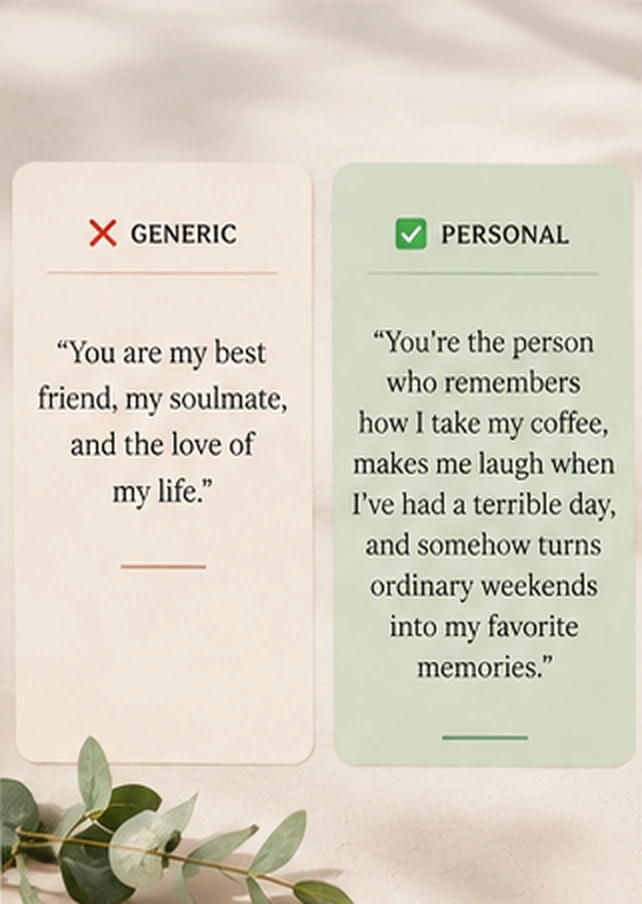
Personal wedding vows reflect the relationship you’ve built together.
Instead of relying entirely on familiar romantic phrases, they include details about your partner, shared experiences, and promises that genuinely matter to both of you.
Consider these two examples.
Generic:
“You are my best friend, my soulmate, and the love of my life.”
Personal:
“You’re the person who remembers how I take my coffee, makes me laugh when I’ve had a terrible day, and somehow turns ordinary weekends into my favorite memories.”
Both express love, but the second reveals something about the relationship.
You don’t need an extraordinary love story to write meaningful vows. Some of the most powerful details are wonderfully ordinary.
Think about the conversations you share, the challenges you’ve faced, and the little habits that make your relationship feel like home.
The goal isn’t to impress your wedding guests. It’s to say something your partner will recognize as genuinely yours.
How to Write Wedding Vows in 7 Simple Steps
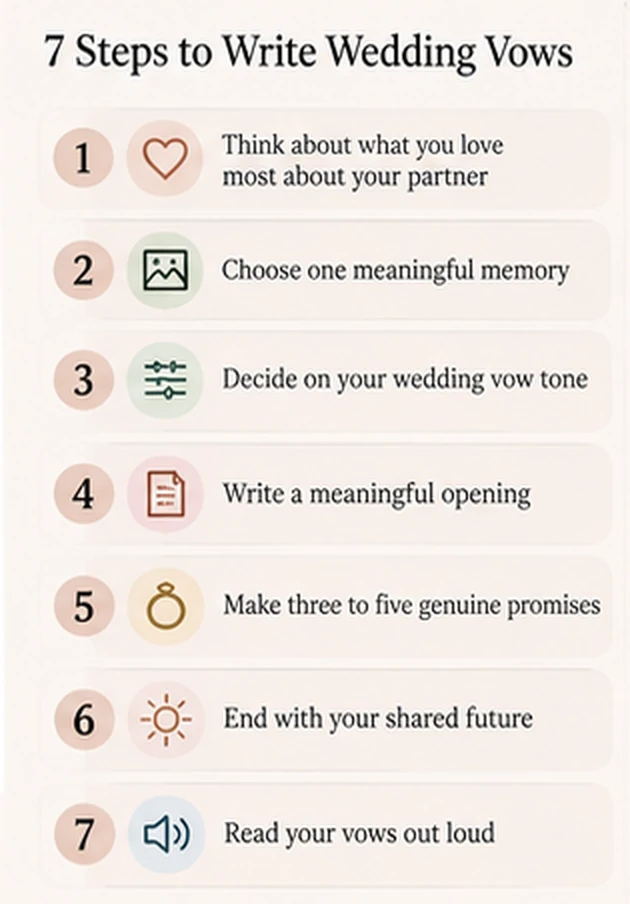
If you’re staring at a blank page, don’t try to write your vows perfectly from beginning to end.
Start by collecting your thoughts, then shape them into something meaningful.
Step 1: Think About What You Love Most About Your Partner
Before writing complete sentences, ask yourself a few questions:
- What did I first notice about my partner?
- When did I realize this relationship was something special?
- What qualities do I admire most?
- How does my partner make ordinary days better?
- What have we learned together?
- What am I most excited about in our future?
Write down your answers without editing them.
You might remember your first date, a difficult moment when your partner supported you, or a small everyday routine that always makes you smile.
For example:
“I love how you always call to make sure I got home safely.”
That may seem like a simple detail, but it tells a meaningful story about care and thoughtfulness.
Writing tip: Choose one or two details that feel especially important. You don’t need to describe your entire relationship.
Step 2: Choose One Meaningful Memory
A personal story can make your wedding vows more memorable, but it should serve a purpose.
Choose a moment that reveals something about your relationship.
Maybe it was the first time you traveled together. Perhaps it was an ordinary evening when you realized you couldn’t imagine your future without this person.
For example:
“I still remember the weekend our plans completely fell apart. We missed our reservation, got caught in the rain, and ended up eating takeout in the car. Somehow, you made the whole thing feel like an adventure. That’s when I realized that wherever life takes us, I want to experience it with you.”
The point isn’t the canceled plans.
It’s what the experience revealed about the relationship.
Ask yourself:
What does this memory explain about why I want to marry my partner?
If it doesn’t reveal something meaningful, consider choosing a different story.
Step 3: Decide on Your Wedding Vow Tone
Your wedding vows should reflect your personality.
Some couples prefer romantic language, while others feel more comfortable with humor or simple, straightforward expressions.
There’s no single correct style.
Romantic: “Loving you has made every chapter of my life more meaningful.”
Simple: “Life feels better with you in it, and I can’t wait to keep building our future together.”
Funny: “I promise to share the good snacks, even when I was saving them for myself.”
Heartfelt: “You’ve shown me that love isn’t only about beautiful moments. It’s about showing up for each other when life gets difficult.”
You can also combine different tones.
A playful opening followed by sincere promises can feel especially natural for couples who love to laugh together.
Just avoid forcing humor or dramatic language that doesn’t sound like you.
For more inspiration, explore these wedding vow examples for different personalities, including romantic, heartfelt, short, and lightly funny approaches.
Step 4: Write a Meaningful Opening
Starting your wedding vows can feel intimidating, but your opening doesn’t need to be complicated.
Begin by addressing your partner and sharing something true.
Here are a few opening ideas:
- “[Name], when we first met, I had no idea how much you would change my life.”
- “Standing here today, I feel incredibly grateful that we found each other.”
- “You have become my favorite person to share life’s ordinary and extraordinary moments with.”
- “I used to think love was about finding the perfect person. Then I met you and learned that it’s about growing together.”
- “Of all the things I imagined for my future, building a life with you has become my favorite.”
Choose an opening that connects naturally with the rest of your vows.
If nothing feels right, skip the introduction and write your promises first.
You can always return to the beginning once you know what you want to say.
Step 5: Make Three to Five Genuine Promises
Promises are what make wedding vows different from a romantic letter.
They express how you intend to care for your partner and contribute to your marriage.
Instead of making only broad declarations, think about commitments you can practice in everyday life.
For example:
- “I promise to listen with patience, especially when we disagree.”
- “I promise to support your dreams while continuing to build our shared ones.”
- “I promise to be honest with you, even when conversations are difficult.”
- “I promise to celebrate your achievements and stand beside you during setbacks.”
- “I promise to keep finding reasons to laugh together.”
- “I promise to make time for us, even during life’s busiest seasons.”
Try combining two or three serious promises with one personal commitment.
For instance:
“I promise to be your teammate through every unexpected challenge, to listen when you need understanding, and to keep choosing kindness when life feels difficult. And I promise to never stop asking you to dance in the kitchen.”
Your promises don’t need to sound impressive.
They need to be commitments you genuinely want to keep.
Step 6: End With Your Shared Future
Your closing should bring your vows together and leave your partner with one clear thought about your commitment.
You might mention your hopes for the future, the life you want to build, or the promise to keep choosing each other.
Here are some closing ideas:
- “Whatever life brings, I want to face it with you.”
- “Today, I choose you, and I promise to keep choosing you.”
- “I can’t wait to grow older, wiser, and a little sillier together.”
- “You are my favorite part of today and the person I want beside me in every tomorrow.”
- “I promise to keep showing up, keep learning, and keep loving you through every season.”
Your final words don’t need to be dramatic.
Sometimes the simplest promise is the most powerful.
Step 7: Read Your Wedding Vows Out Loud
Once you’ve written your first draft, read it out loud.
This is one of the easiest ways to improve your wedding vows.
Words that look beautiful on a screen can feel awkward when spoken.
As you practice, pay attention to:
- Sentences that are difficult to say naturally.
- Repeated ideas or phrases.
- Words that feel overly formal.
- Places where you might want to pause.
- Whether your vows fit your planned length.
If you repeatedly stumble over a sentence, rewrite it.
If a phrase sounds nothing like something you’d normally say, replace it.
You can also record yourself reading the vows to hear how they flow.
The goal isn’t to sound perfectly rehearsed. It’s to feel comfortable enough with your words to focus on your partner during the ceremony.
The VowVirtue Five-Part Wedding Vow Framework
If you’re unsure how to organize your ideas, use this simple five-part framework.
It provides enough structure to keep your vows focused while leaving room for your personality.
| Part | What to Include | Example |
|---|---|---|
| 1. Opening | What your partner means to you | “You make my life feel fuller in ways I never expected.” |
| 2. Memory | One meaningful moment | “I still remember the night we talked until sunrise.” |
| 3. Appreciation | A quality you admire | “I love your patience and the way you care for people.” |
| 4. Promises | Three to five genuine commitments | “I promise to listen, support you, and keep making time for us.” |
| 5. Future | Your shared commitment | “I can’t wait to build the rest of our story together.” |
This framework isn’t a strict rule.
You can change the order, shorten a section, or leave out a memory if it doesn’t fit your style.
The purpose is to help you move from a collection of feelings to a clear, meaningful set of promises.
Fill-in-the-Blank Wedding Vow Template
Not sure what to write first? Use this simple wedding vow template as a starting point.
Replace the words in brackets with details from your own relationship.
“[Partner’s name], when I think about everything we’ve experienced together, one thing I always remember is [meaningful memory].
That moment reminds me of [what the memory says about your relationship].
I love the way you [quality you admire], and I appreciate how you [something your partner does that makes you feel loved].
Today, I promise to [first commitment].
I promise to [second commitment], even when [a realistic challenge].
And I promise to [third commitment].
As we begin this next chapter, I look forward to [shared dream or future experience].
Whatever life brings, I will keep [your most important promise].
I love you, and I’m grateful I get to build this life with you.”
After filling in the blanks, read everything aloud.
Remove anything that feels unnatural and add a detail that only your partner would recognize.
If you prefer to start with a personalized draft instead of filling out a template, the VowVirtue Wedding Vow Generator helps turn your memories, relationship details, preferred tone, and promises into words you can edit.
How Long Should Wedding Vows Be?
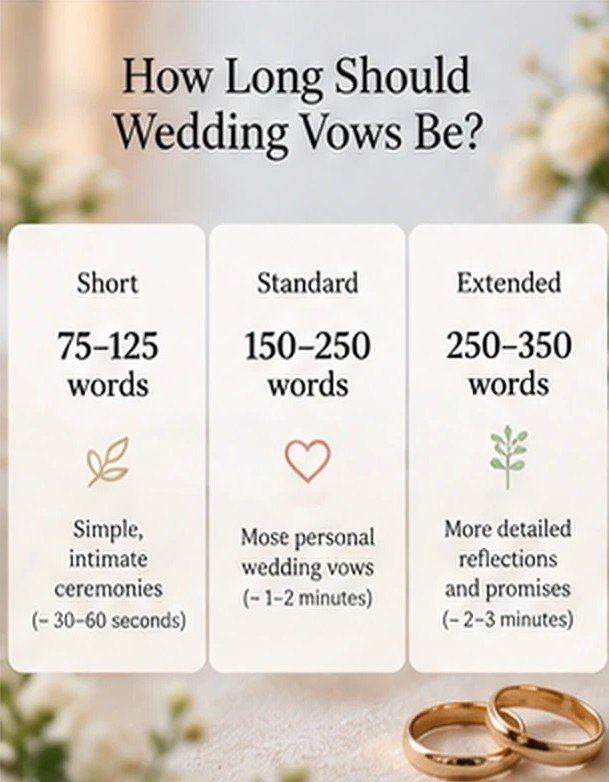
For many couples, wedding vows work well at approximately one to two minutes per person, or around 150–250 words.
This gives you enough time to include a meaningful memory and several promises without making the exchange feel rushed.
However, there is no universal word-count requirement.
Your ceremony style, speaking pace, emotional pauses, and officiant’s guidance all matter.
| Vow Style | Approximate Word Count | Suitable For |
|---|---|---|
| Short | 75–125 words | Simple, intimate ceremonies |
| Standard | 150–250 words | Most personal wedding vows |
| Extended | 250–350 words | More detailed reflections and promises |
These are flexible estimates rather than strict limits.
A useful approach is to agree on an approximate length with your partner before writing.
You don’t need to share your actual vows. Simply deciding whether you’re both aiming for one minute or two minutes can help the ceremony feel balanced.
Remember that you may speak more slowly than usual on your wedding day.
Leave room to breathe, smile, and enjoy the moment.
Wedding Vow Example: Putting the Structure Together
Here’s a short, original example showing how the five-part structure can become a complete set of vows.
Simple and Personal Wedding Vows
“Jamie, when we first met, I didn’t know how quickly you would become such an important part of my life.
I still think about our first road trip, when we got lost, missed our exit, and somehow spent most of the afternoon laughing. That day reminded me how easy it feels to be myself around you.
I love your kindness, your sense of humor, and the way you always make time for the people you care about.
Today, I promise to listen when we disagree, to support your dreams, and to keep finding joy in the ordinary days we share.
I promise to be honest with you, to grow alongside you, and to remember that we’re on the same team.
I don’t know everything our future will bring, but I know I want to experience it with you.
I love you, and I choose you.”
Notice how the vows include a specific memory, personal appreciation, realistic promises, and a forward-looking ending.
If you’d like to explore more styles, read our collection of heartfelt, romantic, short, and funny wedding vow examples.
Common Wedding Vow Mistakes to Avoid
Even meaningful vows can become difficult to follow when they include too many stories, vague promises, or wording that doesn’t feel natural.
Here are five mistakes worth avoiding.
Trying Too Hard to Sound Poetic
You don’t need elaborate metaphors to communicate love.
If you rarely use poetic language in everyday conversation, forcing it into your vows may make them sound less personal.
Choose words that feel comfortable coming from you.
Telling Your Entire Love Story
Your vows aren’t a complete history of your relationship.
Choose one memorable experience that reveals why your partner matters to you.
Save other stories for a private letter or wedding speech.
Making Only Vague Promises
Statements like “I’ll always love you” can be meaningful, but specific commitments give them more depth.
Instead of only saying, “I promise to support you,” try:
“I promise to listen when you need understanding and encourage you when you’re unsure of yourself.”
Including Embarrassing Stories
Personal stories are wonderful, but avoid sharing private details your partner wouldn’t want discussed in front of guests.
A story can feel intimate without making anyone uncomfortable.
Waiting Until the Last Minute
Give yourself enough time to write, edit, and practice.
Starting several weeks before the wedding can make the process feel much less stressful.
You don’t need to work on your vows every day. Even a few thoughtful writing sessions can make a difference.
How to Make Your Wedding Vows Sound Natural
One of the simplest ways to improve your wedding vows is to replace generic phrases with specific details.
Try this editing exercise.
Before: “You always make me happy.”
After: “You know how to make me laugh when I’ve had a difficult day, and you never let me forget that we’re facing life’s challenges together.”
Before: “I promise to support you forever.”
After: “I promise to believe in your dreams, celebrate your successes, and stand beside you when things don’t go as planned.”
The second versions aren’t necessarily more poetic.
They’re simply more personal.
Read each sentence and ask yourself:
“Would I actually say this to my partner?”
If the answer is no, rewrite it.
You don’t need to sound like a professional writer.
You need to sound like the person your partner knows and loves.
Should You Use an AI Wedding Vow Generator?
An AI wedding vow generator can be useful if you know what you want to express but struggle to organize your thoughts.
The key is treating the result as a starting point, not the finished version.
A personalized generator works best when you provide meaningful details about your relationship.
Instead of entering only “I love my partner because they’re amazing,” describe a favorite memory, qualities you appreciate, and promises you want to make.
The VowVirtue Wedding Vow Generator lets you provide relationship details, choose a tone and length, and describe the memories and promises you’d like to include.
It creates a personalized starting draft that you can review and refine.
You can begin generating a draft through the tool and unlock the full polished result through its paid option.
If you’re also preparing wedding speeches or organizing your wedding-day schedule, the VowVirtue Wedding Toolkit combines the Vow Writer, Speech Writer, and Timeline Generator.
Whatever writing method you choose, your final vows should reflect your own experiences, feelings, and commitments.
Your Final Wedding Vow Checklist
Before your ceremony, make sure you can answer yes to these questions:
- Do my vows sound like something I would naturally say?
- Have I included a meaningful detail about our relationship?
- Are my promises genuine and realistic?
- Have I removed repeated or unnecessary sentences?
- Would my partner feel comfortable hearing these words in front of guests?
- Have I read everything aloud at least twice?
- Do my vows fit the approximate length we agreed on?
- Have I checked any ceremony requirements with our officiant?
- Do I have a printed copy or vow booklet ready?
You don’t need to memorize your vows.
Reading from a small card or booklet is completely appropriate, especially if you’re worried about becoming emotional.
The most important thing is being present with your partner.
Frequently Asked Questions About Writing Wedding Vows
How do you start writing wedding vows?
Start by listing what you admire about your partner, one meaningful memory, and three promises you want to make. Organize those ideas into a short opening, a personal reflection, your promises, and a closing statement. You can revise the first sentence after finishing the rest.
What should personal wedding vows include?
Personal wedding vows usually include an expression of love, something meaningful about your relationship, a few genuine promises, and a commitment to your shared future. A brief memory or lighthearted detail can make them more personal, but neither is required.
How many promises should wedding vows have?
Three to five promises are a useful starting point. Focus on commitments that matter to your relationship, such as listening, being honest, supporting each other’s goals, and making time for your partnership.
Can wedding vows be funny?
Yes. Humor can make wedding vows feel natural and personal, particularly for couples who often joke together. Include a lighthearted memory or playful promise, but balance it with sincere commitments and avoid embarrassing your partner.
Do wedding vows have to be the same length?
No. Both partners don’t need to use exactly the same number of words. However, agreeing on an approximate speaking time can help create a balanced ceremony while allowing you to keep the wording a surprise.
Is it okay to read wedding vows instead of memorizing them?
Absolutely. Reading your vows from a card or booklet is common and practical. It helps you focus on delivering your promises clearly instead of worrying about forgetting your words.
Can you write personal vows for a religious wedding?
That depends on the ceremony and religious tradition. Some religious ceremonies require specific wording or limit personalized vows. Ask your officiant before making plans. You may be able to share personal promises in another part of the ceremony or exchange them privately.

Your Wedding Vows Don’t Have to Be Perfect. They Have to Be Yours.
The most meaningful wedding vows aren’t necessarily the longest, most romantic, or most poetic.
They’re the words that reflect your relationship and the commitments you’re ready to make.
Start with a memory. Think about what you admire. Make promises you genuinely want to keep. Then edit everything until the words feel natural when you say them aloud.
And if you’re having trouble finding the right opening, remember that you don’t have to begin with a blank page.
The VowVirtue Wedding Vow Generator can help you turn your thoughts into a personalized first draft.
You bring the memories, the feelings, and the promises. The generator helps you organize them into words you can make your own.
Because the best wedding vows don’t sound like they could belong to anyone.
They sound like you.
One Comment